Honey and Cinnamon?

Ingredients: Honey and Cinnamon.

Ingredients: Honey and Cinnamon.

I keep seeing things on Facebook and elsewhere promoting the many health benefits of honey and cinnamon mixed together. I have actually seen claims that it is a “cure-all,” something that if it were true, I’m sure doctors would be prescribing it for all these dying cancer patients, and the rest.

On the surface, I would say that cinnamon is simply a spice, but perhaps it has chemical properties of which I am not aware. And honey? It’s basically sugar. Sugar is the exact opposite of what your body needs to heal. People with hyperglycemia (i.e. diabetics) have wounds that won’t heal because there’s too much sugar in their blood. Too much sugar encourages infections to grow.

But the number one thing I’ve seen “honey and cinnamon” advertised to cure is obesity. “Lose weight with honey and cinnamon!” the ads scream. And I don’t know if that’s true or not. It’s one thing to make a claim like this, but it’s another thing to back it up with evidence. And so my question is this: does anybody know anyone personally who has actually tried this? The claims abound, but I haven’t heard one testimonial. You know, like “I did the honey and cinnamon diet and lost 30 pounds in three months!” “I took their honey and cinnamon advice, and in just a month I lost six pounds!” Something like that. But there’s nothing. On the contrary, current research shows that eating carbohydrates actually leads to an INCREASED risk of cancer. If you’re really interested, here’s this 32 minute video from Dr. Craig Thompson MD, at the Sloan-Kettering Cancer Center, in which he states, “You overfeed somebody with carbohydrates and you dramatically increase their cancer rate.”

If this is the first time that you’re hearing the idea that carbohydrates are actually not good for you, I would suggest you either read “Wheat Belly” by William Davis, “Good Calories, Bad Calories” by Gary Taubes, or at the very least, the much easier to read “Why We Get Fat”, also by Gary Taubes. If you would prefer to have it spelled out for you in a movie, I would highly suggest you watch the funny and informative documentary “Fat Head” by Tom Naughton.

So, back to the original question: does anybody know someone that tried this honey/cinnamon thing and lost X amount of weight in Y amount of time without changing anything else in their daily routine? Because I’m getting tired of this advice showing up in my Facebook feed. Everybody seems to think it’s a good idea, but nobody’s trying it, at least not that I’ve heard.
Posted in Uncategorized | 2 Comments

Feeling Bad

For some reason today I’ve been almost overcome with a feeling of despondency. I lost my job over a month ago, and I’ve not been able to find a new one. Sitting in church this morning. It seemed as if everything was getting on my nerves and I felt worse by the minute. I kept asking myself, “Why do I feel so down?”

When we feel like this, the temptation is to look outward or inward. We look outward to other people and think, “Why do I have this problem and they don’t? Why do they get those good things and I don’t?” We look inward and think untrue thoughts about ourselves. We think we aren’t worth anything to anybody. We think we aren’t any good.

Looking inward is a lack of faith. We can make ourselves become depressed by telling ourselves things that are not true.

Looking outward is called covetousness. We’ve all heard the question, “Why do bad things happen to good people?” But with covetousness, we are asking, “Why do good things happen to other people and not to me?” Covetousness is where you tell God, through your desires, that either you don’t think He knows what is best for you, or that He is unable or unwilling to give you what you do not have. Coveting is a lack of faith in God.

When we feel down, when life seems to be pressing down on us, when we feel like nobody cares; that’s when we need God the most. Instead of looking inward or outward, we should look upward. We need to remember that God loves us, and if we are believers, there is an amazing home waiting for us to enjoy forever after we are done with this short, short life. And not only that, but Jesus said in John 10:10, “I came that they may have life, and have it abundantly.” God wants us to succeed in being he people He wants us to be.

I looked out today at the winter landscape. We had temperatures in the 50’s for the past few days, only to wake up this morning to fresh snow on the ground. After a record setting winter of snowfall, we are more than ready for spring. We want spring right now, not in a month or two.

I looked at the trees, with their bare branches partially covered with snow. I thought about how God has promised that spring will come eventually. Those trees, which are now bare and dead-looking, will burst with new life and fruit. And this reminds me that, even though right now I have no job, I don’t know how I’m going to pay my bills, and I don’t know what’s going to happen in the future, God knows. He knows all things, He loves me, and He has a perfect plan for my life. His plan doesn’t match my plan, but His plan is infinitely better than mine.

As a result, I need to look upward. I need to keep trusting in God. I need to do my best with what I have and wait on Him to give me what He KNOWS is best for me.

Proverbs 3:5-8
Trust in the Lord with all your heart
And do not lean on your own understanding.
In all your ways acknowledge Him,
And He will make your paths straight.
Do not be wise in your own eyes;
Fear the Lord and turn away from evil.
It will be healing to your body
And refreshment to your bones.

Posted in Uncategorized | 2 Comments

Attention Video Services

I subscribe to Netflix for their online streaming video content. Because I go to school, I have an annual subscription to Amazon Prime, which comes with a video service. I also have a few video services available to me that I could use to rent new movies. Among them are VUDU and the online rental option that comes with my Direct TV service. There are other services out there, but I don’t subscribe for reasons I am about to state.

But first, a question: Why did Blockbuster go out of business? I can tell you why, and it’s pretty simple. They refused to adapt to a changing business model. What does that mean? It means that, for years they charged $4 per movie (give or take), and when Netflix started charging a set amount per month to rent as many DVD’s as you could watch, Blockbuster did nothing. When Redbox kiosks started popping up all over the place, allowing people to rent a DVD for $1 per night, with no late fees and ease of return at any location, Blockbuster did nothing. It wasn’t until Redbox and Netflix were firmly established and Blockbuster felt the sting of lower revenues did they decide to do something, but even then they only decided to eliminate late fees. They left their rental fees the same. As a result, the customer base of Blockbuster continued to gravitate to Redbox and Netflix. Eventually, Blockbuster joined the dodo and the Tyrannosaur: they went extinct. And all because Blockbuster refused to accept a new reality.

I’ve talked about this before. But there is a difference: Blockbuster is gone now. And so here’s the new problem I alluded to earlier. If I want to watch a new movie, I rent it from Redbox. Why? because it costs between $1 and $2. If I want to watch a movie from Direct TV, VUDU, or iTunes, it costs $4 or more. Why would I do that? As a result, I don’t rent movies from any of these services.

So my point is this: if these video rental services would lower their prices to $2 or less per movie, I would use their services instead of Redbox. I’m thinking they could even put Redbox out of business. So what’s it going to be? Your move, guys.

Posted in Uncategorized | 2 Comments

Who was the Pharaoh of the Exodus?

I grew up watching The Ten Commandments with Charlton Heston as Moses. It was on TV every Easter. As a kid, I wondered why they showed this movie every Easter, since it had nothing to do with Easter. I didn’t know much about the Bible at that point, and so I didn’t realize that the Passover, which was instituted during the events in Exodus, was a picture of salvation through Jesus Christ, who would become our Passover Lamb over 1400 years after the first Passover.

While studying for my last post about the chronology of the world, I did a little research into ancient Egypt around the time of Joseph and Moses. I found something interesting, which I saw before, but I wasn’t sure if I had ever said anything here about it, so here goes. Egyptologists have determined the dates for each Dynasty and each Pharaoh in Egypt. I don’t know the methods they used, and so I can’t vouch for their reliability, but after seeing what I’ve gathered, you have to admit it seems pretty compelling.

According to my timeline (see my last post), Joseph came to Egypt in 1898 BC. According to Egyptologists, that means he came to Egypt during the reign of Amenemhat II. The Pharaoh who had the dream about the 14 cows was his son Senusret II. He died right after the seven years of plenty in 1878 BC. Two years later, Jacob moved his family (i.e. the Hebrew nation) to Egypt in 1876 when Senusret III was Pharaoh. There were six complete dynasties of Pharaohs that ruled in between Jacob’s arrival and Moses’ birth.

We now fast-forward through the 350 years from Jacob’s arrival in Egypt to Moses’ birth. The Pharaoh when Moses was born in 1526 was Ahmose I (this is the Pharaoh who killed the babies). He died when Moses was two years old. His son Amenotep I ruled for 21 years, and then Thutmose I ruled for the next ten years. He was succeeded by Thutmose II, who was Pharaoh for 7 years before Moses left Egypt for Midian at age 40.
Thutmose II was Pharaoh for seven more years, and then his son Thutmose III became Pharaoh in 1479. He ruled for 33 years before Moses came back in 1446. He ruled until 1425 , which was 21 years after the Exodus.

Cecil B. DeMille would have you believe that Rameses I was the Pharaoh of the Exodus. There are other theories and other dating methods, and it may not be possible this side of heaven to know for sure who the Pharaoh of the Exodus was. But one piece of information makes me think it was probably Thutmose III. Sources state that Thutmose III’s son Amenemhat was the crown prince, the heir apparent, the next Pharaoh in line. However, he died sometime between the 24th and 35th years of the reign of Thutmose III (that is, sometime from 1455-1444), and his half-brother Amenhotep II became pharaoh. Since the Exodus happened in 1446, this accounts for why Amenemhat died between 1455-1444. Therefore, it seems pretty clear to me that Amenemhat was probably the son of Pharaoh that died in the 10th plague as stated in Exodus 12:29.

I did all this research, and then found out that others have done the same research and came to the same conclusion: Thutmose III was the Pharaoh of the Exodus. I’ll have to ask Moses when I get to heaven, but for now, I’m pretty sure.

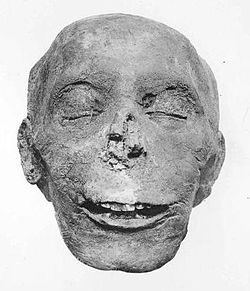
Thutmose III, a man who defied God, and lost, as all men do who defy God.

Thutmose III, a man who defied God, and lost, as all men do who defy God.

Posted in Uncategorized | 9 Comments